A compost recipe needs three things at the same time: enough water for biological activity, available nutrients, and connected spaces through which air can move. These conditions must hold in the actual mix, not just in a calculation. A batch can have the expected average moisture and still contain wet clumps with very little airflow. [1, 2, 3]
1. What a bulking agent does
Rigid particles such as clean wood chips or chipped branches can keep spaces open between softer particles under the weight of the windrow. For aeration, some of those spaces need to remain air-filled and connected. A dry, fine ingredient may reduce the moisture percentage without improving the structure; if it fills the gaps between large particles, it may actually restrict airflow. Excess coarse material does not guarantee a good recipe either. Large particles have less surface area relative to their volume, and resistant wood breaks down more slowly and can increase the fraction retained on the screen. [1, 2, 5]
An ingredient can serve several functions, which should be checked separately: structure for airflow, moisture adjustment through its contribution of water and dry matter, and carbon or nitrogen supply. For example, rain-wetted chips may still provide structure but have less effect on moisture than the same mass of dry chips. If you recycle screening oversize, check for contaminants, check its moisture, and make sure the particles can still provide structure before including it in the recipe. See oxygen, porosity and aeration. [1, 2, 5]
2. From feedstock data to a trial batch
- Characterise the ingredients: wet mass, moisture content, particle size, rigidity and tendency to compact. Bulk density helps with handling and layout. Measure it on the actual mix because the volumes of the separate ingredients do not necessarily add up once mixed.
- If you are working towards a target C:N ratio, obtain carbon and nitrogen values on a consistent basis, such as percentages of dry matter. Calculate the ratio from the total masses of carbon and nitrogen, not by averaging the individual ratios. Choose starting points for the feedstocks and technology rather than a rigid target that ignores biodegradability. [1, 3, 4]
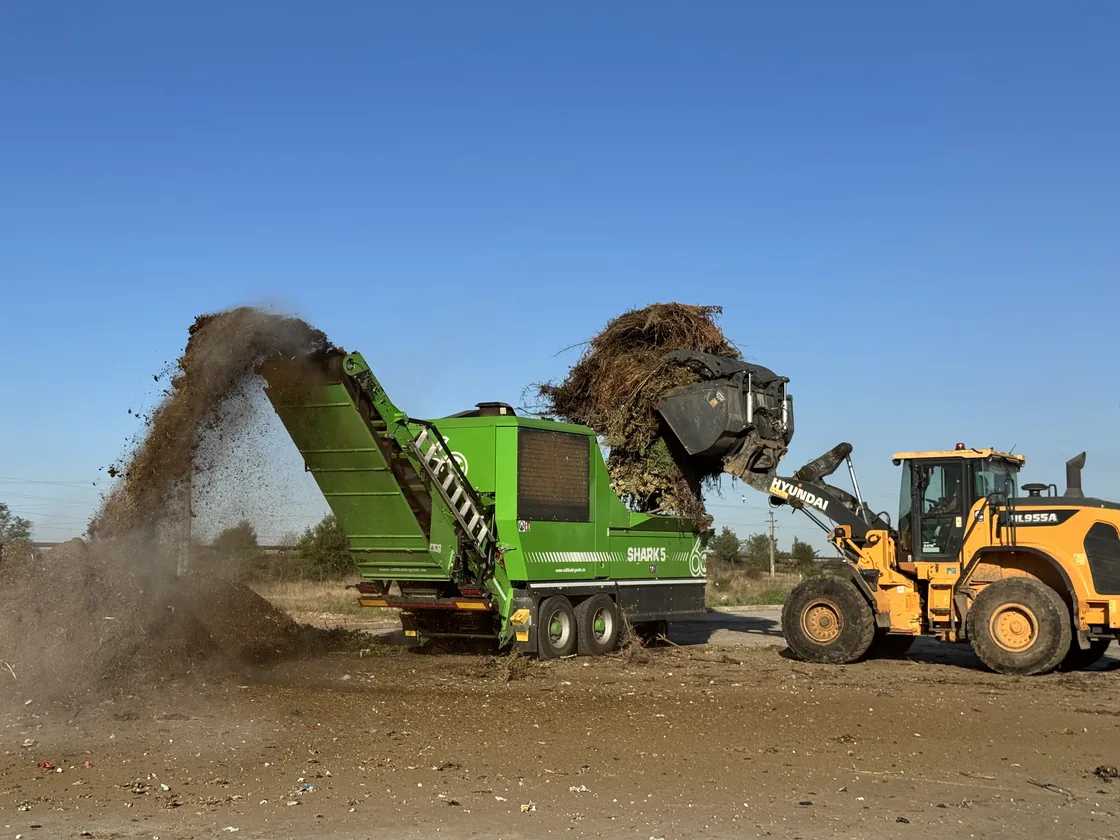
- Sort out contaminants before shredding where the process allows, weigh the ingredients and blend them to achieve an even distribution without needlessly breaking down the material that gives the mix its structure. If you dose by loader bucket, check the mass per bucket periodically. The same bucket can hold a different mass after rain or when packing changes.
- After mixing, check moisture and structure in several parts of the batch, not just at the surface. Once the windrow is formed, track settlement and temperature and, where monitoring is in place, oxygen within the material and the response to aeration. Record what changed compared with the previous batch. [1, 2]
3. Worked example: the same doses can give a different moisture content
Assume 800 kg of material A at 70% moisture is blended with 200 kg of material B at 20%. Percentages are on a wet basis; no water or material is added or lost during preparation.
| Ingredient | Wet mass | Water | Dry matter |
|---|---|---|---|
| A | 800 kg | 800 × 0.70 = 560 kg | 240 kg |
| B | 200 kg | 200 × 0.20 = 40 kg | 160 kg |
| Total | 1,000 kg | 600 kg | 400 kg |
Moisture = 600 kg / 1,000 kg × 100 = 60%.
If rain raises the moisture of B to 40% and you keep both masses the same, B contributes 80 kg of water and the mix reaches 64%. If you want to get back to exactly 60% by changing the dose while keeping A fixed, the wet mass x of B satisfies 560 + 0.40 × x = 0.60 × (800 + x), with all masses in kg. The result is x = 400 kg: 720 kg of water in a total mix of 1,200 kg. In this scenario you have doubled the dose of B and increased the total mass. Reassess composition, structure and handling capacity rather than applying this solution automatically.
These results check the water balance only. The example uses 60%; it is not a universal target and does not confirm adequate C:N or porosity. Check the actual moisture once the material is mixed. See moisture and dry matter and the carbon-to-nitrogen ratio. [1, 3, 4]
4. What you see, what to check and what you can change
| What you see | What to check | What to adjust if the cause is confirmed |
|---|---|---|
| Wet clumps after mixing, even though the batch average looks right | Moisture in the clumps and in the loose material separately; ingredient distribution and mixing method | Change the feeding order or how you break up and distribute clumps without needlessly shredding the structural material. |
| The windrow settles and liquid appears at its base | Moisture, fines, windrow height and drainage paths; on installations with forced aeration, check air distribution | Correct the structure or geometry and remedy drainage where needed. Running the fan faster will not by itself resolve waterlogging in the pores. |
| A new batch heats up slowly | Batch age, intake temperature, mass, moisture and available air; the woody fraction and C:N data | Do not add nitrogen based on temperature alone. Address the cause supported by your checks and follow the response in the same batch. |
These are diagnostic starting points, not operating instructions for a specific plant. Where practicable, try one change at a time and follow the batch at the same measurement locations. See feedstocks and contaminants and process monitoring and troubleshooting.
References and further reading
- NC State University Extension. Large-Scale Organic Materials Composting, “Feedstocks”, “Moisture”, “Surface area” and “Testing”
- US EPA. Approaches to Composting, “Pile Structure”, “Moisture Content” and “Oxygen Flow”
- Cornell Composting. C/N Ratio, mix calculations and the moisture–C:N trade-off
- Cornell Composting. Moisture Content, wet-basis calculation and how to solve for the second ingredient
- International Compost Seminar 2026, Austria. 7 October (day 3), “Raw Material Handling”, PDF pp. 17–20, especially p. 18 on preserving structure after shredding and screening. Organised by Compost Systems GmbH.