A blower can be running normally while the centre of the pile still receives too little oxygen. What matters is both the volume of air the system moves and the path it takes through the material. Aeration supplies oxygen to microorganisms and can carry heat and moisture away from the composting mass. The same setting might help a hot, wet batch but cool or dry a less active batch too much. [1, 3, 4, 6]
How does oxygen reach the microorganisms?
Porosity is the share of the material's volume occupied by pores, whether they contain air or water. Air-filled porosity, also called free air space, counts only the share of the total volume occupied by air. The pores must also be connected for air to pass through the pile. Two mixes with the same air-filled pore volume may offer different resistance to airflow if one has narrower, disconnected or more winding pathways. [1, 2]
Air moves mainly along the larger pores. Oxygen then diffuses towards areas of lower concentration and through the thin film of water on the particles to reach the microorganisms. Microbial activity needs water, but when water fills the pores, it restricts both airflow and oxygen transport. [6] Fine particles, compaction under the weight of upper layers or machinery driving over the pile can close off other routes. Where dense areas sit next to looser ones, air takes the path of least resistance. A header may show adequate airflow while a dense zone is poorly aerated. During the active phase, readily degradable material can drive oxygen consumption faster than airflow can replenish it. [1, 2, 5]
Passive aeration, turning and forced aeration
With passive aeration, warm air rises out of the material and cooler air takes its place through openings at the sides or base. The effect depends on the temperature difference and the permeability of the mix. Turning redistributes the material and can break up clumps. The oxygen introduced during turning is used up over time; if the mix settles back into a compact structure, the benefit may be short-lived. [1, 3, 4]
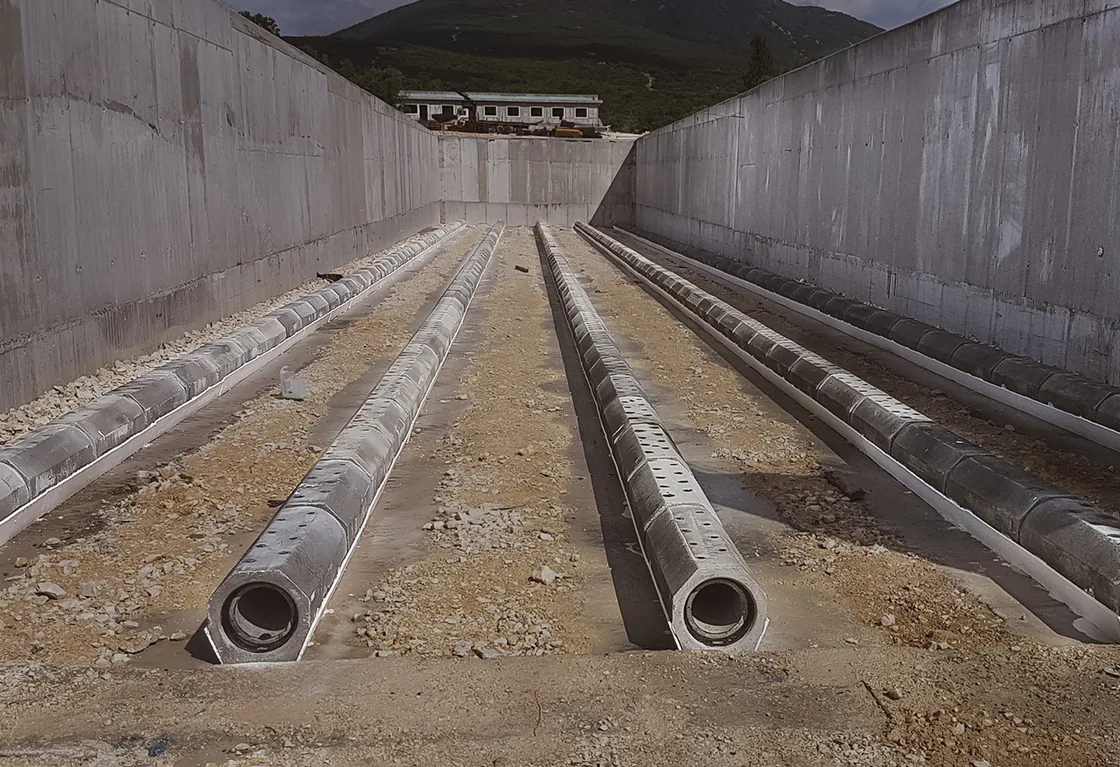
In floor-aerated systems, positive aeration blows air upwards through the floor and into the composting mass. Process air leaves across the available pile surface; in an enclosed installation it can be collected separately by a ventilation system designed for that purpose. With negative aeration, air enters at the pile surface, is drawn down through the material from top to bottom, and exits through the floor into collection ducts. In practice, it can also enter through the sides. These directions apply to the arrangement with air ducts at the base; check the layout drawing for the actual flow path. [3–5]
Negative aeration provides a collected exhaust stream that can be routed to treatment, for instance to a biofilter suited to the gas and flow rate. Check where the ducts lead, how condensate drains and when the blowers are running. Floor extraction does not automatically capture air released during intake, loading, unloading or turning. A biofilter treats only the air that reaches it; site-wide emissions control must be assessed separately. [4, 5] See Odours and emissions and Composting technologies.
Fan → floor → material → exposed surface
Surface and sides → material → floor → collection duct
Two examples: how much air fits in the pores and what an oxygen probe tells you
Pore volume, not moisture by mass. Imagine 100 m³ of mix containing 55 m³ of solids, 15 m³ of water and 30 m³ of air. Total porosity is 45% and air-filled porosity is 30%. If the pores retain another 5 m³ of water uniformly, with no swelling, drainage or change in overall volume, the air volume falls to 25 m³. Air-filled porosity is now 25%: a drop of 5 percentage points, not a relative drop of 5%. This example is a simple volume balance. It predicts neither airflow nor wet-basis moisture content. In practice, water may spread unevenly and compaction also changes the total volume. See Moisture and dry matter.
Concentration and flow rate are different quantities. Suppose a pore-gas sample reads 12% O₂ by volume. The reading describes the gas at that location and time. It is neither the oxygen percentage in the solids nor the airflow required. Record the probe depth and position, the stage of the batch and the time since the blower started; check calibration and repeat the measurement elsewhere under comparable conditions. Gas from a shared header combines different streams and cannot replace local readings when looking for a poorly aerated zone. Confirm airflow separately in m³ of air/h at the specified temperature and pressure; express turner throughput in m³ of material/h. [5, 7]
What to check before adjusting the system
| Observation | What might explain it | What to check or adjust if confirmed |
|---|---|---|
| The blower runs, but one area remains wet and dense | Water occupies the pores, the mix has compacted or air is bypassing that zone | Compare temperature and O₂ readings at different depths; check moisture, structure and ducts. If the mix is at fault, test changes to blending and structure on a batch rather than simply increasing airflow. |
| Flow falls in one branch at the same blower setting | Increased resistance in the material, a blockage or a damper out of position | Compare branch flow and pressure under comparable conditions. Check distribution, ducts and condensate drainage under the site's procedures. |
| Material dries near the air inlet while another zone stays wet | Air or water is distributed unevenly; the aeration cycle may amplify the difference | Check the moisture and temperature profiles. Adjust the aeration cycle or watering gradually according to the cause, then measure again. |
| Temperature spikes | Biological activity may be high or the system may be removing too little heat | Take readings at several locations and compare O₂, moisture and blower operation. High temperature alone does not prove oxygen deficiency. |
Interpret measurements together and record any change made before the next reading. On a new line or a capacity upgrade, operational adjustments cannot replace measuring airflow resistance, checking the blower operating point and testing distribution across zones. For more on operations, see Process monitoring and troubleshooting and Mix preparation and bulking agents.
References and further reading
- Cornell Composting, Tom Richard. Inadequate Porosity, pore structure, compaction and oxygen transport
- Poulsen and Moldrup (2007). Air permeability of compost as related to bulk density and volumetric air content, study of two compost types, abstract and sample limitations
- US EPA. Approaches to Composting, passive and active aeration sections
- FAO (Food and Agriculture Organization of the United Nations) (2003). On-farm composting methods, chapter 3: turned windrows, aerated static piles, pressure and suction layouts
- Environment Agency. Biological waste treatment: appropriate measures for permitted facilities, sections 8.5–8.7; technical reference from England, not a Romanian requirement
- Cornell Composting, Tom Richard. Oxygen Transport, convection and diffusion in compost
- USDA NRCS. National Engineering Handbook, Part 637, chapter 2: oxygen and carbon dioxide monitoring; aerated static piles
- International Compost Seminar 2026, Austria, 8 October (day 4). “Composting Technology of Compost Systems”, PDF pp. 5–6 and 8–10, examples of in-floor ducts and air circuits. Organised by Compost Systems GmbH.